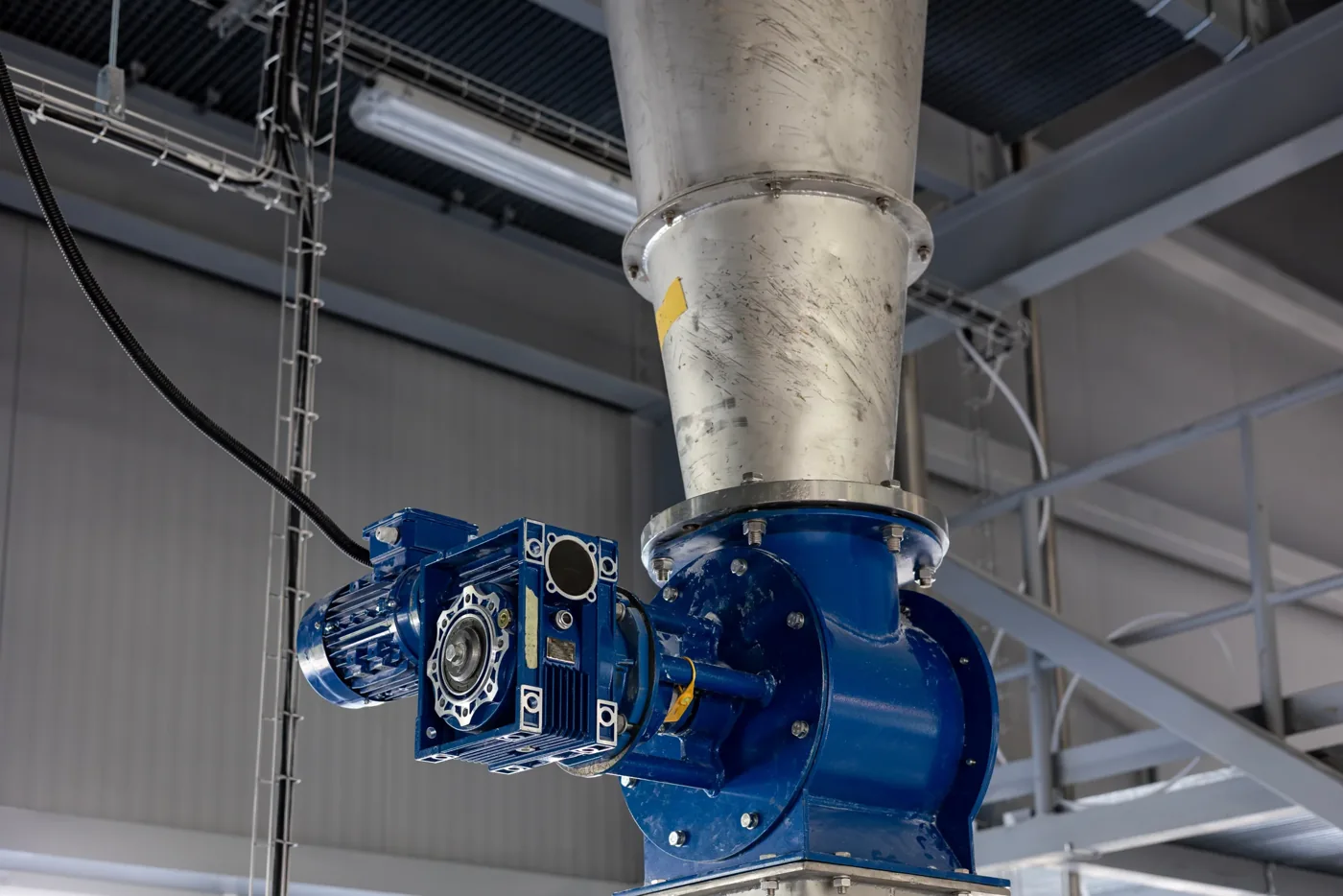
When a silo stops discharging, the restriction may be at the outlet, in the equipment receiving the product or within the stored material above. Identifying which part has stopped working matters because an equipment fault and a mass of retained material require different corrective work. An open discharge valve, by itself, does not establish that product is moving through the vessel.
What actually stopped: the outlet or the transfer system?
The first distinction is between material failing to leave the silo and material failing to move onwards after leaving it. Both can produce the same operational complaint: no product reaches the next stage of production.
Consider the discharge arrangement as three connected areas:
- Stored material: Powder, grain or another bulk solid must be able to move towards the discharge opening.
- Outlet equipment: The valve, feeder or discharge transition must provide an available route for material.
- Downstream transfer: A screw conveyor, pneumatic conveying line or receiving system must accept the discharged product.
A stopped screw conveyor can prevent continued transfer even when material remains capable of leaving the silo. Equally, a functioning conveyor cannot collect material that is being held above the outlet.
This distinction prevents an unnecessary assumption that every interruption requires work inside the storage vessel.
What external observations can establish
Existing operational records and instrumentation can help narrow the likely restriction without disturbing the contents. Useful information includes when the flow stopped, whether discharge reduced gradually or ended suddenly, and whether the same problem has occurred after previous deliveries.
Operators can compare the last recorded product movement with the status information available from the installed equipment. A normal running indication is useful, but it does not necessarily prove that material is passing through the equipment.
Likewise, a silo level reading may indicate retained stock without showing its position or whether that stock can move. The most valuable evidence often comes from considering several observations together rather than relying on a single instrument.
Restriction locations and their different implications
At the discharge opening
Material may accumulate or compact around the outlet, particularly where the transition narrows. A restriction in this area can interrupt otherwise available flow. The condition of the outlet assembly and its operating status need to be distinguished from the condition of the product immediately above it.
Above the outlet
Some bulk solids can form a stable obstruction while leaving a void or partly open space underneath. Other material may remain attached to the walls or occupy regions outside the active flow path.
This means that a visibly open outlet does not prove the material above it is moving. Where a suspended mass is suspected, the behaviour is considered in more detail under silo bridging.
Beyond the silo
The apparent blockage may instead be associated with a downstream valve, transfer connection or receiving plant. In that situation, the assessment should establish whether material is reaching the transfer interface before treating the silo contents as the cause.
When is silo unblocking the relevant work?
Silo unblocking becomes relevant when retained, compacted or otherwise obstructing material prevents the intended discharge path from functioning. The location, quantity and stability of the material affect what corrective work is appropriate.
The distinction has important safety consequences. The Health and Safety Executive’s confined-space guidance identifies grain and other bulk solids as potential causes of asphyxiation and explains why work inside enclosed vessels requires particular controls. A suspected suspended blockage must not be treated as an invitation to enter underneath it.
Before corrective work is selected, the practical question is whether the evidence points to mechanical transfer equipment, the discharge interface or material retained within the vessel. A clear account of that distinction makes the subsequent assessment more useful and keeps the work focused on the actual restriction.